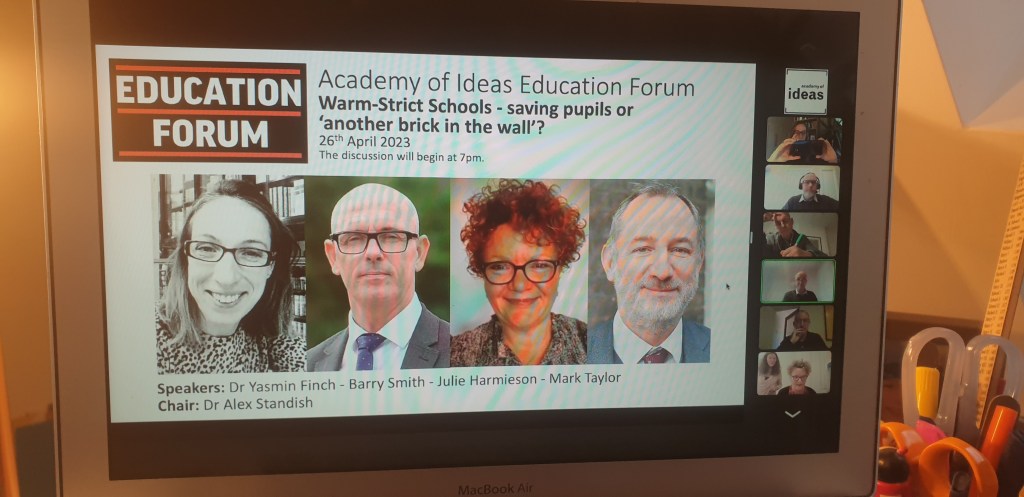
Warm-Strict Schools: saving pupils or ‘another brick in the wall’?
26th April 2023
Our Chair, Dr Yasmin Finch, was invited to present ‘The Parent View’ on strict behaviour policies in schools at this event – more info here.
Here is what she said…
The parent view on behaviourist policies
As soon as a parent first selects a nursery or a childminder, and then perhaps – if they have a choice- a school, they are making decisions about who will look after their children and whether they are comfortable with how their child is being treated in that setting.
They take a view on what the rules are, what the behaviour culture is like, what’s expected of the children and how their child is delt with. I, and most parents I know, want clear rules that are fair and help their child learn in a calm and positive environment.
But what happens when their child starts to tell them they’re unhappy or struggling because of the punishment system at their school? Punishments for small things, day in day out. What if it escalates and they develop anxiety, depression, panic attacks, behavioural tics, IBS, UTIs… they see a counsellor, a GP, a therapist…
Of course, any parent would go to the leader in that setting and raise those issues, expecting it to be taken seriously… However over the past few years, and the rise in behaviourist policies, this has not always been the case.
Certainly, in the school my children attend in Cambridgeshire, these matters have not been addressed.
As a Parent Forum of 500 members, we conducted robust research to assess the extent of the problem. We surveyed 350 families with a combined total of over 500 children represented, evidencing the conditions above across the student population and their direct correlation with the new behaviour policies at the school.
A local GP who contacted us identified they were seeing, and I quote, “More anxiety related to punishment at school as opposed to the usual problems with friendships or academic work.”
Perhaps the point I would like to raise most strongly in this session is to ask why, when the parents do make their concerns known, are they treated with such scepticism by the leadership of schools and academy trusts? It feels like those with the theory are not listening to those experiencing the reality.
There has been much media coverage of parent, and wider community, reaction when this marginal, extreme style of behaviour management is implemented in a particular school.
A quick google shows articles about schools in Essex, Manchester, Devon, Norfolk and elsewhere where parents have been raising concerns, for a number of years now, about these methods. Things like children having their food removed as a punishment or being sent to isolation for incorrect uniform.
Behind this coverage are parents deeply distressed by the negative impact these measures are having on their children, parents who have tried the normal way of dealing with these matters, but have been met with an unswerving commitment to a theory that is being aggressively implemented.
At the start of this year, I had never heard of SLANT or warm-strict policies, by the end of March I’d started a government petition to investigate the mental health impact of them and end the Behaviour Hub programme that promotes them.
Back in January, my children were increasingly unhappy and saying increasingly disturbing things about the new policies the academy trust were implementing – like line up in the playground in silence every morning for a uniform inspection with their hands raised in salute-like gesture to senior leadership, or they were anxious they would be in detention for forgetting a spare pen.
Of course, some parents feel these kind of measures suit their children. In our survey 3% of parents felt like this, but 64% felt the policies were having a negative impact on the mental health and wellbeing of their children. Where there is room for choice, of course, a minority of parents may deliberately choose behaviourist schools, and it may work well for them in specialist situations, but this breaks down when schools and academy trusts force a general implementation of these extreme policies.
- There are other methods that deal with serious behaviour problems in schools, extreme behaviourist techniques are not the only answer. As a parent, I would certainly appreciate our academy trust taking a more balanced approach.
- Do these techniques deal with the minority of severe misbehaviour and bullying that we all agree needs tackling? A youth Offending Officer who contributed to our research advised, and I quote, “I understand there are concerns with disruption in schools but generally those [children] that are inclined to this are not really affected by these punishments and just take it in their stride! It will have a bigger adverse impact on those that try hard and make the odd mistake” Unquote.
- What defines success with these measures? If it is only exam statistics, schools and trusts are failing to take into account other vital areas. Tom Bennet, behaviour advisor to the government, identifies 5 key areas in school life… behaviour, academic achievement, safety, welfare and wellbeing. Our evidence shows welfare and wellbeing are being compromised by a singular focus on behaviour.
- The question must be asked, if a behavioural system has clear evidence of harm to some children, is it acceptable to continue with it for all, even if some parents report it suits their child well?
This is what some of our parents said in our research…
Parent quote…
“The system has also caused significant stress, especially for our year 7 who checks his bag repeatedly every evening and morning in case he’s forgotten equipment. His mental health has deteriorated. Our Year 10 did the same when the current policy was brought in but has since lost such respect for the school that she no longer cares. Neither have ever been in trouble. The threat impacts already well-behaved children negatively.”
Next parent quote…
“Sunday nights are particularly awful for his anxiety, affecting his sleep, which then has a knock on effect. He suffered with ticks as a toddler and these have returned due to the stress.
Next parent quote…
There has been an impact on my Year 10 child especially. She is a well-behaved, conscientious student who feels that through the systems such as SLANT and morning address she is treated like she is a much younger pupil.
And a quote from our student survey…
The term SLANT feels like a dog command
When issues as serious as these are raised about a style of behaviour management in schools, it seems, at best, incompetent and, at worse, a serious safeguarding failure, if they are left unaddressed.
For decades, parents have been happy with normal school rules, they want calm and ordered learning environments, children to feel pride in their education, to get good grades in their exams… But perhaps educational theorists imposing these techniques need to realise that warm-strict is still strict, and ‘strict’ is something UK education left behind long ago.
As a parent newly exposed to this enclave of thinking, it has left me asking has reality been sacrificed to ideology in education? In our Academy Trust it certainly feels like it has.
 St Ivo Parents Forum